The learning city
When the city learns
Urban intelligence and the new sensitivity of ecosystem design
The city that measures but does not yet understand
In recent decades we have learned to measure many things in cities and buildings: traffic flows, pollution, temperature, journeys, energy use. We have sensors, platforms and data dashboards, and this shapes a new urban landscape; tools such as mobile phones and sports apps give us a great deal of anonymous data about how people live and move. But after all this effort to quantify, have we really learned to understand the city? Perhaps data alone is not knowledge. Perhaps information is only useful if it helps us think about the territory better and act with greater awareness.
From the efficient city to the learning city
Programmes such as AI4Cities, which brings together several European cities, focus on researching and developing artificial intelligence (AI) solutions to reduce carbon emissions and help cities become more sustainable and adaptive.
The starting point is simple:
If cities are the main sources of emissions, they must also be the main places for learning and regeneration.
In Helsinki, Amsterdam or Copenhagen, technology is not about control but about reading the city to better understand its dynamics. For example, they have introduced algorithms that anticipate energy demand according to the weather, traffic lights that adjust to real flows and street occupancy, and models that combine mobility and air quality to define more precise policies. This is probably the real value of urban AI: becoming a data-analysis tool for learning, acting and planning more dynamically.
It also gives us climate data, and predictive models make it possible to anticipate climate risks, optimise energy use and plan with equity and health in mind. But technology alone guarantees nothing; the research focuses on how this information is used as a tool for analysis.
The age of interpreted data
Data are no longer neutral. It is important to choose the indicators that matter for the quality of cities in order to measure and plan. What we choose to measure is what we choose to value. That is why AI4Cities projects have focused on defining indicators that reflect the real quality of urban change: CO₂ emissions, energy efficiency, travel time, climate comfort and data interoperability. In Copenhagen, analysing energy demand has improved the thermal efficiency of public buildings by 50%. In Helsinki, a smart traffic-light model has cut travel time and emissions by 30%.
The value of these projects is not only the numerical result, but the collective learning that comes from sensors and cooperation. Measuring is not counting. Measuring is understanding how the territory and its people respond to our actions.
Technology with sensitivity: the new material of design
Technology is not the opposite of sensitivity; it is an extension of it. When we work with daylight, local materials or cross-ventilation, we are already applying a form of intelligence. AI can simply be one more layer of perception. Projects such as FranchetAI, inspired by plants that filter CO₂, or Optibility and Atmosphere, which integrate environmental analysis models, show how technology can learn from nature.
Properly understood, technology does not reduce the designer’s role; it multiplies it. It lets us see the invisible: flows of energy, noise, shade and perception.
This is the new material of urban design: data with a soul.
From smart cities to adaptive cities
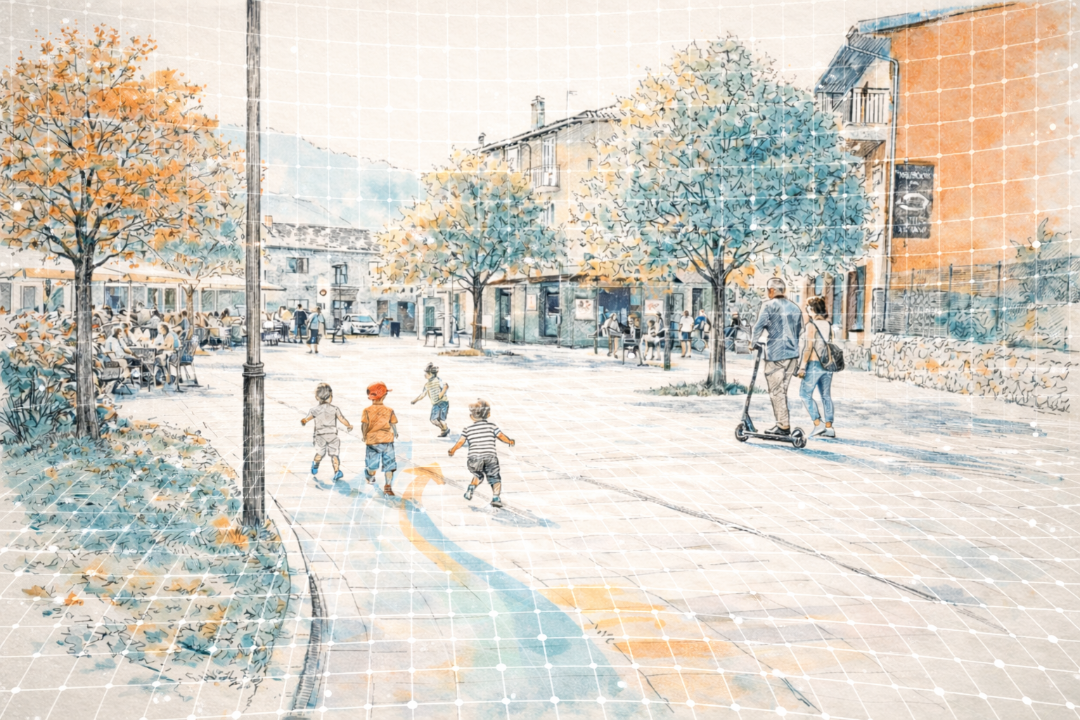
The smart city concept put technology at the centre, but often forgot the human dimension. Now we talk about adaptive cities: living systems that evolve with change and adjust their behaviour to the climate, mobility and people’s daily lives. They do not aim to be perfectly efficient, but deeply aware. They accept complexity and turn it into a driver of creativity. True urban intelligence is not the one that calculates, but the one that understands.
Learning from change: the city as a living ecosystem
Every urban project should be an opportunity to learn, both for the teams who design it and for the whole city.
Data make evaluation possible, but learning happens when those data become better decisions, fairer policies and livelier spaces.
At URBIQ we sum it up like this:
Planning with data and intelligence also means designing with sensitivity and awareness.
The city is not a machine to be optimised, but an ecosystem to be understood. The future of urban planning is not only about making cities sustainable, but about making cities that can learn, adapt and take care of us. Because, in the end, a city’s most valuable intelligence is the one it shares with the people who live in it.