Decree-Law 6/2026: new opportunities to live on non-developable land in rural Catalonia?
What does Decree-Law 6/2026 aim to do?
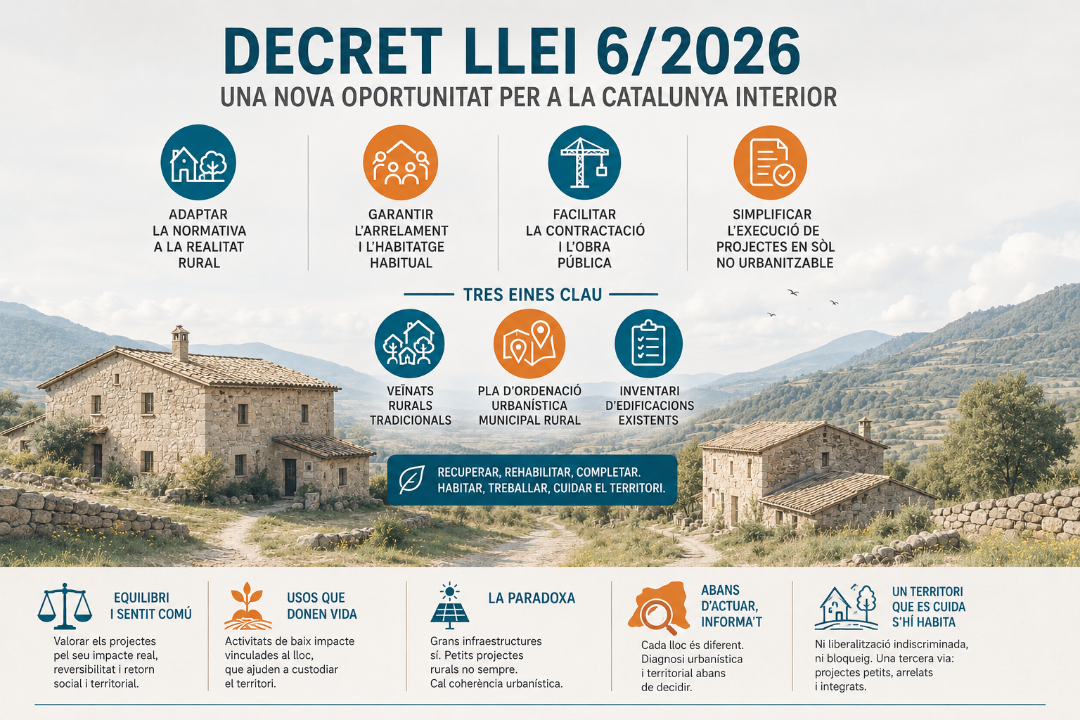
The decree has four main objectives: to adapt planning regulations to the reality of rural municipalities, to support people settling and staying in them, to make procurement and public works easier, and to simplify the delivery of projects on non-developable land. This purpose is stated expressly in the text of the decree.
This approach matters because it recognises a reality that many municipalities have been living with for years: ordinary planning tools are often too complex, too slow or poorly suited to villages with small populations, limited technical resources and territorial dynamics very different from those of cities.
Decree-Law 6/2026 tries to partly correct this mismatch, mainly through three instruments:
- Traditional rural hamlets (veïnats rurals tradicionals).
- The rural municipal urban development plan (POUM rural).
- The inventory of existing buildings on non-developable land.
These three tools can have significant effects on the renovation of farmhouses (masies), the recovery of rural buildings and, in some cases, the creation of primary homes.
The big new feature: traditional rural hamlets
One of the most interesting contributions of the decree is the creation of traditional rural hamlets as a planning category.
Under the new Article 47 bis, these are settlements located on non-developable land within rural municipalities, with a proven history of more than 100 years, containing buildings used as primary homes, even if they lack the basic urban services typical of urban settlements.
This category is important because it recognises something very common in inland Catalonia: small groups of buildings, clustered farmhouses, rural outskirts or historic settlements that are not really urban land, but are not an isolated house with no territorial structure either.
In these hamlets, the main use is housing. Planning may allow other compatible uses, as long as they do not undermine the rural character of the whole. Existing buildings can also be renovated and extended, horizontal division can be allowed if planning permits it, and even new buildings can be accepted to replace existing ones or to fill gaps accessible from a public road that complete the delimited rural hamlet.
This is a very significant change.
However, it should not be confused with a general liberalisation of housing on non-developable land. It does not mean that a new house can be built on any rural plot. It means being able to complete or recover existing rural hamlets with history, structure, access and territorial coherence.
The inventory of buildings on non-developable land: a key tool for recovering existing buildings
The second major new feature is the inventory of existing buildings on non-developable land.
The decree allows rural municipalities to approve an inventory that includes buildings which do not necessarily have enough architectural, historic or heritage value to be part of a farmhouse catalogue, but which, because of their characteristics, functionality and access, can accommodate certain uses.
This new inventory is not a fundamental change, because rural buildings could already be identified through catalogues of farmhouses, rural houses and other buildings. The change is mainly legal and procedural: there is now a specific instrument for rural municipalities that can include buildings without clear heritage value but with the functionality, access and capacity to host some compatible uses. Even so, it does not substantially widen the uses allowed on non-developable land; it is a somewhat more flexible, municipally led way of regulating existing buildings.
Renovating a farmhouse in a municipality without a catalogue: what happens now?
This is one of the most sensitive points for many owners. In many rural municipalities, especially small ones, there is no approved or up-to-date farmhouse catalogue. This creates a major practical difficulty: a farmhouse may exist, may have value and may be recoverable, but if it is not catalogued, the procedure becomes more complicated.
The general rule still states that the reconstruction and renovation of farmhouses, rural houses and other buildings on non-developable land requires general or special planning to identify them in a specific catalogue and justify the reasons for preserving or recovering them.
When this catalogue does not exist, the Regulation on the protection of planning legality requires a specific action project (PAE) to be processed in order to obtain the planning permit for reconstruction or renovation.
Therefore, Decree-Law 6/2026 does not simplify or remove the need to process a specific action project to renovate buildings in municipalities without a catalogue.
Will it be possible to build new homes on non-developable land?
Decree-Law 6/2026 does not allow new homes to be built freely on non-developable land. New construction only really appears within traditional rural hamlets, where new buildings can be allowed to replace existing ones or to fill gaps accessible from a public road that complete the delimited hamlet.
This means that new construction is not conceived as an isolated house in the middle of the countryside, but as an operation to complete, replace or consolidate a pre-existing rural settlement.
The decree states that in certain delimited and regulated traditional rural hamlets, gaps can be filled or existing buildings replaced if this keeps the character of the hamlet and fits into the landscape.
Does the decree address the problem of new uses on non-developable land?
The decree does not yet resolve the underlying debate: which uses do we need to allow on rural land to keep it alive, inhabited, productive and cared for?
For many years, non-developable land has been regulated mainly from a logic of prohibition: avoiding scattered development, protecting agricultural, forestry, environmental and landscape values, and preventing speculation.
This caution is necessary, especially in areas under strong property pressure.
But in much of inland Catalonia, the problem is not always development pressure. It is often the opposite: abandoned buildings, collapsing farmhouses, villages losing population, a lack of economic activity, difficulty maintaining the agroforestry mosaic and a territory that is less and less managed.
In this context, perhaps we should ask a different question: which low-impact uses can help look after the territory?
Not all housing on non-developable land is speculation. Not every activity on rural land is degradation. And protecting the landscape does not have to mean pushing people out of it.
There are small, reversible, integrated, place-based activities that could help keep the territory alive: craft workshops, food workshops, agroforestry projects, educational activities, community services, liberal professions, creative spaces, primary homes linked to managing an estate, land stewardship initiatives and small businesses.
Decree-Law 6/2026 takes a first step in this direction, but it does so very cautiously and always subject to the prior existence of buildings, inhabited groups or traditional hamlets.
The paradox: large infrastructure yes, small rural projects not always
As a country, we have been able to make it easier and faster to locate certain infrastructure on non-developable land when it is considered strategic, as with large solar parks and other facilities linked to the energy transition.
The energy transition is necessary. But so is a territorial transition.
And here a paradox appears: it is often easier to justify occupying a large area of rural land for energy infrastructure than to bring a small existing building back into use for living, working or running a low-impact activity that helps maintain the territory.
This should not be a criticism of renewables, but a reflection on planning criteria.
Non-developable land cannot be available for large infrastructure when it suits us and, at the same time, almost impossible for small local initiatives that can keep people in the area and look after the landscape.
Between indiscriminate liberalisation and administrative gridlock there is a smarter path: assessing projects by their real impact, reversibility, landscape integration, resource use, the traffic they generate, their relationship with farming and the social and territorial return they bring.
What should someone who wants to live in a farmhouse or rural building do?
If you are thinking of buying, renovating or building a rural home on non-developable land, the first step should be a planning and territorial assessment.
You need to analyse what type of land the property is on, its planning classification, whether the municipality is rural, whether it has a farmhouse catalogue and whether the building has architectural, historic, landscape, environmental or social values that justify recovering it. You also need to assess whether residential use is allowed, whether a specific action project is required, whether the building could be part of an inventory or a traditional rural hamlet, and whether there are agricultural, forestry, environmental, heritage or risk constraints. Finally, it is essential to check that access, water, sanitation and energy can be properly resolved, because on non-developable land the project is not just a house: it is a relationship with the place.
It is landscape, farming, paths, services, water management, energy, fire risk, heritage, topography, neighbours and territorial model.
That is why feasibility does not depend only on the owner’s wishes, but on being able to justify that the project makes sense in that specific place.
A new opportunity for inland Catalonia
Decree-Law 6/2026 can be an opportunity to recover existing buildings, strengthen rural hamlets and make primary homes or small activities linked to the territory easier. But it must not become a way to develop rural land covertly or to create second homes disconnected from the municipality. The key is to find a third way: small, justified, integrated projects linked to settlement, local activity and land stewardship.
Before renovating or building on non-developable land, study feasibility
Before renovating a farmhouse, recovering a rural building or planning a home on non-developable land, you need to analyse municipal planning, sector constraints, whether or not there is a farmhouse catalogue and whether a specific action project may be required. Each case may need a different strategy: catalogue, inventory, special plan, traditional rural hamlet or municipal permit. At URBIQ we carry out this assessment from a planning, territorial and data-based perspective, to understand not only what can be built, but which project makes sense for that place, that municipality and that landscape.
Decree-Law 6/2026 opens a door, but it does not yet change the mindset: it still treats non-developable land mainly as a space to be restricted, rather than as a territory that also needs activity, management and human presence to stay alive.
Do you have a farmhouse or a project on rural land? See how we help you check feasibility and obtain approval.