Specific action project (PAE): when is it needed?
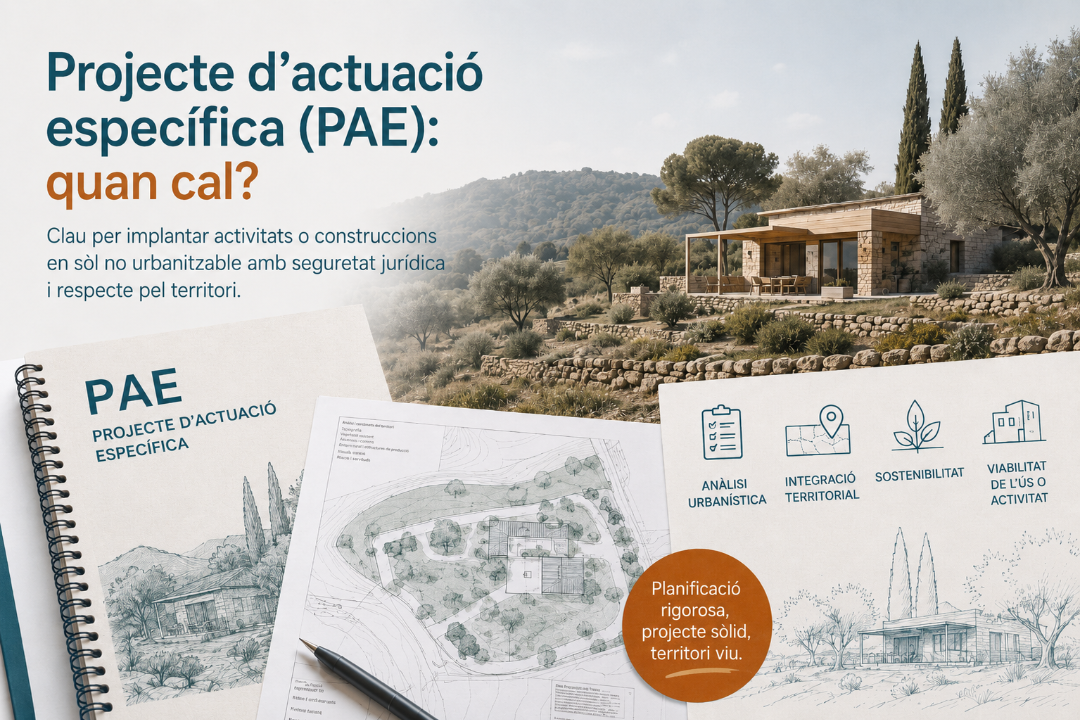
What is a specific action project (PAE) and when is it needed on non-developable land?
A specific action project, commonly known as a PAE (projecte d’actuació específica), is the planning document that must be approved, in certain cases, before a use, activity or construction can be authorised on non-developable (rural) land in Catalonia. The PAE makes it possible to check whether the action is admissible and to define its location, basic characteristics and integration into the territory before drafting a full construction project. It is therefore neither a planning permit nor a detailed design. Once approved, the municipal permit and any relevant sector authorisations must still be obtained. It is sometimes loosely called an “urban action project”, but the term used in Catalan legislation is specific action project.
Much more than a planning procedure
A good PAE starts from a reading of the place and helps the developer turn a need into a feasible proposal. It studies the most suitable location and how the action should relate to the topography, landscape, access roads, paths, neighbouring properties and existing activities. It also makes it possible to define the first criteria for the future architecture:
- the necessary dimensions and heights;
- orientation and siting;
- a single or fragmented volume;
- materials and colours;
- access and earthworks;
- water and energy supply;
- sanitation and other services.
This phase allows alternatives to be compared, constraints to be detected before moving forward, and prevents the form of the action from being determined solely by functional or construction needs.
When is a PAE required?
Whether a PAE is needed depends on the use, the characteristics of the project, the location and the applicable planning. The most common cases include:
- actions of public interest that have to be located in a rural setting;
- outdoor collective activities of a sporting, cultural, recreational or leisure-education nature;
- community facilities and services that are not compatible with urban uses;
- certain access infrastructure, technical services or environmental installations;
- activities and buildings directly linked to the exploitation of natural resources;
- family homes or accommodation for seasonal workers directly linked to a rural holding;
- the opening or restoration of certain paths or access roads;
- service stations and other facilities linked to the road network;
- auxiliary buildings for rural tourism activities;
- the reconstruction or renovation of farmhouses (masies), rural houses and other buildings while the planning does not include the catalogue that allows them to be processed directly.
A PAE may also be required even if no new building is constructed. It can be used to authorise a use of the land or the reuse of an existing building. This could be the case, for example, for certain car parks linked to an activity, depending on their characteristics and the applicable planning.
This list is not exhaustive. On non-developable land, apparently similar actions may follow different procedures depending on the municipality and the territorial or sector constraints involved.
When is a PAE not needed?
If a farmhouse, rural house or other building is included in the catalogue provided for in Article 50 of the Catalan Planning Law, and the proposed use and works comply with its record sheet and the planning, the municipal permit can usually be processed directly. In some cases, however, a report from the Territorial Planning Commission may still be required. As a general rule, a PAE is also not needed for buildings strictly related to an agricultural, livestock or rural activity, provided they are compatible with planning and sector regulations. These actions follow the municipal permit procedure.
This does not mean they are exempt from control. If a new agricultural, livestock or rural building exceeds 5,000 m² of footprint or 12 metres in height, a favourable report from the Territorial Planning Commission is also required, but not a PAE. In any case, any specific conditions set by territorial or municipal planning must be checked.
For the establishment or extension of livestock activities, a period of public consultation and a report from the department responsible for livestock are also required. By contrast, certain adaptation works to an existing livestock activity that do not increase its production capacity may only require a municipal permit.
The regulations also provide exceptions for certain minor installations, auxiliary works, repairs and extensions of previously authorised actions. That is why the specific project should be analysed before starting any procedure.
What must a PAE contain?
The specific action project must be defined in enough detail for the authorities to assess the feasibility and territorial fit of the proposal. Under the Regulation on the protection of planning legality, the document must include at least:
an explanatory report on the action and its purpose; justification of compatibility with territorial, urban and sector planning; land registry and cadastral identification of the affected properties; location, site and footprint plans; a description of existing services and those to be provided; a preliminary technical design of the works, where applicable; and a landscape impact and integration study.
When the action must be linked to a rural holding, the holding must also be identified, its operation described and the need for and proportionality of the proposal justified.
The PAE must include a landscape impact and integration study
Every PAE must include a landscape impact and integration study (EIIP), in accordance with Article 50.1.e of Decree 64/2014. The EIIP is not a mere formal annex. It analyses the landscape and the visibility of the site, compares alternatives and justifies how the action fits in. Among other aspects, it must study: the location and its relationship with the topography; the most relevant viewpoints; volume and heights; orientation and composition; materials and colours; earthworks and vegetation; access, paths and services; and preventive, corrective or integration measures. The study is prepared within the framework of Law 8/2005 on the protection, management and planning of the landscape and Decree 343/2006, which implements it. This landscape work is also a design tool: it helps decide which form, size and siting are best suited to meet the developer’s need while staying consistent with the place.
Who processes and who approves the PAE?
The application is submitted to the town council of the municipality where the action is located. The council processes the file, opens a one-month public consultation, requests the relevant sector reports and grants preliminary approval. It then sends the file to the Territorial Planning Commission, which is responsible for final approval.
So although the final decision lies with the Catalan Government, the town council plays a central role in processing and in the initial assessment of the proposal. The planning permit can be processed at the same time, but it can only be granted once the PAE has been finally approved. As a general rule, the specific action project is valid for one year from notification of final approval to apply for the permit, unless the Territorial Planning Commission sets a longer period with reasons.
PAE or special urban plan?
Not every action on non-developable land can be processed through a PAE. Certain infrastructure relating to urban systems not provided for in the planning may require a stand-alone special urban plan. This option can also be considered when the action has a larger territorial scope, needs to organise several elements or requires planning rules that go beyond authorising a specific project. So the first decision should not be how to draft the PAE, but whether the correct route is a direct permit, a specific action project or a special urban plan.
Legal framework
The main regulation is found in the consolidated text of the Catalan Planning Law, approved by Legislative Decree 1/2010 of 3 August, especially Articles 47 to 50. The procedure, documentation, exceptions and validity of PAEs are developed in Decree 64/2014 of 13 May, approving the Regulation on the protection of planning legality. On landscape, Law 8/2005 on the protection, management and planning of the landscape and Decree 343/2006, which implements it, must be taken into account.
What is the advantage of a PAE for the developer?
The main value of a PAE is that it provides planning validation of the use, location and basic criteria of the action before developing a full construction project and committing to a larger investment. Drafting it also makes it possible to study alternatives and detect possible planning, environmental, landscape or sector constraints in good time. This helps adjust the proposal, reduce risks and gain legal certainty. Before starting, it is important to determine the correct route: a direct permit, a PAE or, for larger actions, a special urban plan.
At URBIQ we see the PAE as the first phase of the project: a tool to read the territory, shape the developer’s needs and find a feasible, proportionate solution that is consistent with the place.
Do you have a farmhouse or a project on rural land? See how we help you check feasibility and obtain approval.