Listen and transform the city
Contemporary urban planning can no longer be understood as a simple arrangement of volumes and streets on a blank plan. In a context of climate crisis, social tension and technological change, the city has revealed itself as a complex ecosystem that calls for a much deeper and, above all, more human approach. In this setting, the conversation between Xavier Rico of URBIQ and Iñaki, founding partner of Paisaje Transversal, is a valuable document for understanding where the planning of our environment is heading.
The origin of a critical vision
Paisaje Transversal was not born in a conventional office, but in academic criticism during the years of the property bubble (2007). Iñaki recalls how a group of students at the Madrid School of Architecture began to question a model of urban design that ignored the environment and collective quality of life. What began as a blog and an association organising workshops has grown into a professional office of 15 people with bases in Madrid, Valencia, Barcelona and the Basque Country, and has become a reference in urban regeneration.
Watch the full conversation on YouTube (in Spanish).
The mantra: “Listen and transform”
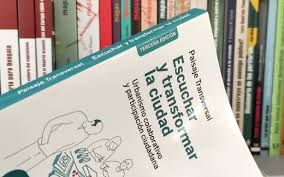
If one phrase sums up this new way of working, it is the title of Paisaje Transversal’s book: “Listen and transform the city”. For Iñaki, the role of the planner has changed radically: no longer a distant analyst or an academic shut away with ideas, but someone who must spend time building things together.
This “listening” has many dimensions: listening to citizens, social stakeholders and technical staff, but also to data and the environment. The “transforming” part is the commitment to real action; as Iñaki puts it, you have to get involved and get your hands dirty with projects that genuinely improve places and the lives of the people who live there.
The power of data: making the subjective objective
One of the most relevant points of the interview is the discussion of working methods. Both URBIQ and Paisaje Transversal see rigour as a core value. The key lies in combining quantitative and qualitative analysis.
On the one hand, Geographic Information Systems (GIS) are used to analyse scientific urban variables based on objective data. On the other, these data are checked against what Iñaki calls “participatory indicators”. Through data tables and thousands of citizen interactions, they can capture feelings and opinions and classify them as positive, negative or constructive proposals.
Bringing these data streams together produces a diagnostic map far closer to reality than open data alone. Even so, Iñaki issues a necessary warning for the Big Data era: “data are cold” and can be “tortured” to say whatever you want. The final decision must therefore rest with the professional, who uses their intuition, understood as “a huge sum of knowledge”, to make informed decisions.
AI and the “human robot”
When talking about technology, artificial intelligence (AI) appears not as a magic wand but as a tool for exponential acceleration. Iñaki explains how AI helps them with mechanical writing tasks and, above all, with coding: using Python to build their own tools that take data management further.
The position, however, is clear: AI must never replace the planner’s subjective judgement. “We are still far more complex robots than machines,” says Iñaki, urging professionals not to get lazy and never to hand their intuition over to technology.
Governance and the three golden rules of participation
The conversation also helps to rescue the idea of public participation, which has often been emptied of meaning. Iñaki prefers to talk about governance, understood as decisions built jointly by politicians, technical staff, citizens and private stakeholders.
After 20 years of learning, Paisaje Transversal has distilled three golden rules for a process to work:
- Honesty: be clear from the start about what can and cannot be decided.
- Consistency: never run a participation process without a real project behind it. Wasting people’s time is the worst mistake you can make.
- Multiple channels: for the process to be transparent and reliable, offer everything from social media and websites to paper forms for older people.
The city as a collective work without an author
One of the most powerful and honest reflections of the meeting concerns authorship in urban planning. Against the figure of the “genius” architect, Iñaki argues that “urban projects do not have an author; they belong to the community”.
Given how slow urban processes are, sometimes lasting decades, and the fact that a project passes through hundreds of hands (different political teams, technical staff and construction companies), transforming a neighbourhood is always the sum of many people who have done good work over time. This view calls for great professional humility.
The dilemma of regeneration and politics
Finally, the interview addresses urban regeneration, especially in vulnerable areas such as the Mariola neighbourhood in Lleida or the Ensanche of Albacete. Iñaki reminds us that urban planning is not neutral; it is political. Every decision about greening a street or improving housing has a direction and a social impact.
This leads to a dilemma with no single answer: how do you improve a neighbourhood without pushing out its residents (gentrification)? According to Iñaki, regeneration is a delicate issue that can only be tackled seriously with strong public housing policies, something that is still lacking.
Conclusion: the ethics of error
The conversation ends with an exercise in brutal honesty: the need to evaluate public policies. Iñaki argues for going back to the places where action has been taken, measuring whether health or population indicators have improved and learning from mistakes. This mindset of continuous improvement and transparency is ultimately what defines Urban Planning 4.0: a practice that uses the greatest technological rigour to serve people’s wellbeing with humility.